The Integrated Post-Flood Health Services for Disaster-Affected Communities in Aceh
DOI:
https://doi.org/10.64126/dedikasisosial.v2i1.58Keywords:
Aceh, Community Service, Disaster Health, Maternal Health, Medical CircumcisionAbstract
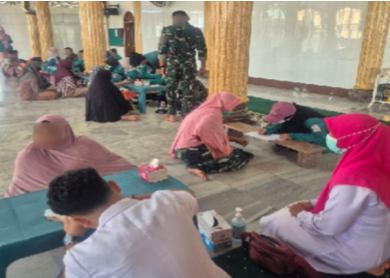
Flood disasters can severely disrupt access to essential healthcare services, particularly in vulnerable communities where health facilities and infrastructure are damaged. In November 2025, Tropical Cyclone Senyar caused extensive flooding in Pidie Jaya Regency, Aceh, resulting in disruption of healthcare access in Blang Awe Village. This community service program aimed to restore access to essential health services through an integrated post-disaster health intervention consisting of general health screening, maternal and child health (MCH) services, and medical circumcision. A participatory action approach was implemented from February 1–20, 2026, involving collaboration between the Faculty of Medicine, Universitas Syiah Kuala, Pidie Jaya District General Hospital, village authorities, and community health workers. The intervention included health screening, antenatal care (ANC), health education, and medical circumcision. Program outcomes were evaluated based on service achievement, community participation, stakeholder feedback, and perceived benefits. A total of 97 participants underwent health screening, identifying a high burden of non-communicable diseases, including hypertension (45%) and hypercholesterolemia (55.6%). ANC services were provided to 11 pregnant women with high-risk conditions identified, including suspected gestational diabetes and mild hypertension. Medical circumcision was successfully performed for eight school-aged children without complications. The program met its targets and received positive feedback from community stakeholders, indicating strong acceptance and perceived benefits. This integrated intervention successfully addressed healthcare gaps following flood-related disruption of health infrastructure by supporting continuity of essential services, improving early detection of health risks, and strengthening community resilience. Long-term sustainability requires strengthening local health worker capacity, referral systems, and integration into primary healthcare services.
Downloads
References
Ahmadi, S., Khankeh, H., Sahaf, R., Dalvandi, A., Hosseini, S. A., & Jalilvand, S. (2018). Health Needs of Older Adults After Natural Disasters: A Systematic Literature Review. Trauma Monthly, 23(4). https://doi.org/10.5812/traumamon.60622
Akselrod, S., Banerjee, A., Collins, T. E., Acharya, S., Artykova, N., Askew, I., Berdzuli, N., Diorditsa, S., Eggers, R., Farrington, J., Jakab, Z., Ferreira-Borges, C., Mikkelsen, B., Azzopardi-Muscat, N., Olsavszky, V., Park, K., Sobel, H., Tran, H., Vujnovic, M., … Allen, L. N. (2023). Integrating Maternal, Newborn, Child Health and Non-Communicable Disease Care in the Sustainable Development Goal Era. Frontiers in Public Health, 11, 1183712. https://doi.org/10.3389/fpubh.2023.1183712
Alderman, K., Turner, L. R., & Tong, S. (2012). Floods and Human Health: a Systematic Review. Environment International, 47, 37–47. https://doi.org/10.1016/j.envint.2012.06.003
Andayani, H., & Ishak, S. (2020). Manajemen Pelayanan Kesehatan pada Pengungsi Pasca Bencana. Jurnal Kedokteran Nanggroe Medika, 3(3), 23–29.
Becker, J., Johnston, D., Lazrus, H., Crawford, G., & Nelson, D. (2008). Use of Traditional Knowledge in Emergency Management for Tsunami Hazard: A Case Study from Washington State, USA. Disaster Prevention and Management, 17(4), 488–502. https://doi.org/10.1108/09653560810901737
BNPB. (2025). Info Bencana Data dan Informasi Kebencanaan Bulanan Teraktual (Vol. 6, Issue 1).
BPS Aceh. (2023). Statistik Daerah Provinsi Aceh.
Dartanto, T. (2022). Natural Disasters, Mitigation and Household Welfare in Indonesia: Evidence From a Large-Scale Longitudinal Survey. Cogent Economics & Finance, 10(1), 2037250. https://doi.org/10.1080/23322039.2022.2037250
Dinas Kesehatan Aceh. (2025). POSKO HEOC ( Health Emergency Hari Ke-34.
Doocy, S., Daniels, A., Murray, S., & Kirsch, T. D. (2013). The Human Impact of Floods: a Historical Review of Events 1980-2009 and Systematic Literature Review. PLoS Currents, 5. https://doi.org/10.1371/currents.dis.f4deb457904936b07c09daa98ee8171a
Drain, P. K., Halperin, D. T., Hughes, J. P., Klausner, J. D., & Bailey, R. C. (2006). Male Circumcision, Religion, and Infectious Diseases: an Ecologic Analysis of 118 Developing Countries. BMC Infectious Diseases, 6(1), 172. https://doi.org/10.1186/1471-2334-6-172
Du, W., FitzGerald, G. J., Clark, M., & Hou, X.-Y. (2010). Health Impacts of Floods. Prehospital and Disaster Medicine, 25(3), 265–272. https://doi.org/10.1017/S1049023X00008141
Fernandez, L. S., Byard, D., Lin, C.-C., Benson, S., & Barbera, J. A. (2002). Frail Elderly as Disaster Victims: Emergency Management Strategies. Prehospital and Disaster Medicine, 17(2), 67–74. https://doi.org/10.1017/s1049023x00000200
Hammad, M., Foster, A. M., Aissaoui, A., Clark, E., Elamurugan, K., Rajendra, K. L., El Mowafi, I. M., & Kobeissi, L. (2023). Exploring the Feasibility of Establishing a Core Set of Sexual, Reproductive, Maternal, Newborn, Child, and Adolescent Health indicators in Humanitarian Settings: Results From a Multi-Methods Assessment in Jordan. Reproductive Health, 20(1), 56. https://doi.org/10.1186/s12978-023-01589-w
Harville, E., Xiong, X., & Buekens, P. (2010). Disasters and Perinatal Health:a Systematic Review. Obstetrical & Gynecological Survey, 65(11), 713–728. https://doi.org/10.1097/OGX.0b013e31820eddbe
Jia, Z., Tian, W., Liu, W., Cao, Y., Yan, J., & Shun, Z. (2010). Are the Elderly More Vulnerable to Psychological Impact of Natural Disaster? A Population-Based Survey of Adult Survivors of The 2008 Sichuan Earthquake. BMC Public Health, 10, 172. https://doi.org/10.1186/1471-2458-10-172
Kemenkes RI. (2019). Laporan Riskesdas 2018 Nasional. Badan Penelitian dan Pengembangan Kesehatan.
Kemenkes RI. (2020). Pedoman Pelayanan Antenatal Terpadu.
Kemenkes RI. (2021a). Buku Informasi Cegah dan Kendalikan Penyakit TidakMenular (PTM).
Kemenkes RI. (2021b). Gerakan Perilaku Hidup Bersih dan Sehat dalam Data Riset Kesehatan Dasar. https://ayosehat.kemkes.go.id/gerakan-perilaku-hidup-bersih-dan-sehat-dalam-data-riset-kesehatan-dasar
Krill, A. J., Palmer, L. S., & Palmer, J. S. (2011). Complications of Circumcision. The Scientific World Journal, 11, 2458–2468. https://doi.org/10.1100/2011/373829
Kronenberg, M. E., Hansel, T. C., Brennan, A. M., Osofsky, H. J., Osofsky, J. D., & Lawrason, B. (2010). Children of Katrina: Lessons Learned About Postdisaster Symptoms and Recovery Patterns. Child Development, 81(4), 1241–1259. https://doi.org/10.1111/j.1467-8624.2010.01465.x
Mendrinos, A., Loyd, E., Jagger, M., Comer, C. C., & Gohlke, J. M. (2026). The Effect of Flooding on Low Birthweight and Preterm Birth: a Systematic Review and Meta-Analysis. BMC Public Health, 26(1). https://doi.org/10.1186/s12889-026-26521-2
Mol, B. W. J., Roberts, C. T., Thangaratinam, S., Magee, L. A., de Groot, C. J. M., & Hofmeyr, G. J. (2016). Pre-eclampsia. Lancet (London, England), 387(10022), 999–1011. https://doi.org/10.1016/S0140-6736(15)00070-7
North, C. S. (2007). Epidemiology of Disaster Mental Health. In Textbook of Disaster Psychiatry. Cambridge University Press.
Ohta, Y., Araki, K., Kawasaki, N., Nakane, Y., Honda, S., & Mine, M. (2003). Psychological Distress Among Evacuees of a Volcanic Eruption in Japan: A Follow-Up Study. Psychiatry and Clinical Neurosciences, 57(1), 105–111. https://doi.org/10.1046/j.1440-1819.2003.01086.x
Okeke, S. R., Okeke-Obayemi, D. O., Njoroge, M. R., & Yaya, S. (2024). Collateral Damage: The Overlooked Reproductive Health Crisis in Conflict Zones. Reproductive Health, 21(1), 198. https://doi.org/10.1186/s12978-024-01941-8
Pemkab Pidie Jaya. (2025). KABUPATEN PIDIE JAYA _ Berita Rekapitulasi Dampak Bencana dalam Surat Pernyataan Bencana Nomor_ 300.
Rosyida, A., Aziz, M., Firmansyah, Y., Setiawan, T., Pangesti, K. P., I., F. K., & Assaudi, B. (2024). Data Bencana Indonesia 2024.
Sahoo, K. C., Negi, S., Patel, K., Mishra, B. K., Palo, S. K., & Pati, S. (2021). Challenges in Maternal and Child Health Services Delivery and Access during Pandemics or Public Health Disasters in Low-and Middle-Income Countries: A Systematic Review. Healthcare (Basel, Switzerland), 9(7). https://doi.org/10.3390/healthcare9070828
Situmorang, A. (2003). Adolescent Reproductive Health in Indonesia (Issue September).
Sphere Association. (2018). The Sphere Handbook : Humanitarian Charter and Minimum Standards in Humanitarian Response.
Venkatesh, G. (2022). A Brief Analysis of SDG 3 – Good Health and Well-being – and its Synergies and Trade-offs with the other Sustainable Development Goals. Problemy Ekorozwoju, 17(2), 140–147. https://doi.org/10.35784/pe.2022.2.15
Wasis, B. (2025). Dampak Siklon Senyar Terhadap Kerusakan Tanah, Longsor dan Banjir di Sumatera.
WHO. (2009). Male Circumcision Under Local Anaesthesia (Vol. 3).
WHO. (2016). WHO Guideline on Antenatal Care.
Downloads
Published
How to Cite
Issue
Section
License
Copyright (c) 2026 Hendra Kurniawan, Muhammad Dwi Hafizh Putra Setyo Raharjo, Muhammad Ammar Ibnu Syakir, Farah Narizki, Lyra Angelica

This work is licensed under a Creative Commons Attribution-ShareAlike 4.0 International License.